
Last Updated: January 28, 2026
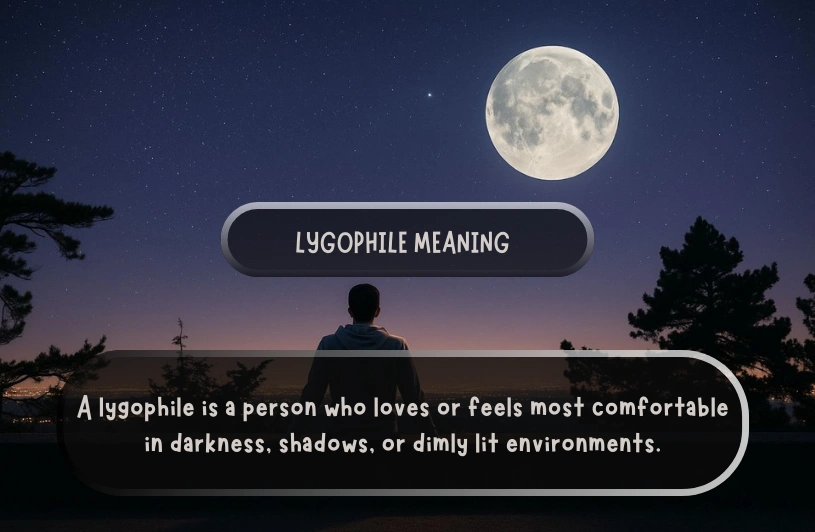
A Lygophile Meaning is someone who finds comfort, peace, or fascination in darkness and dim environments. Unlike nyctophobia (fear of darkness), lygophiles feel genuinely drawn to nighttime, shadows, and low-light settings.
Disclaimer: This article provides educational information about the term “lygophile” and circadian preferences. It is not medical advice. If you experience severe sleep disturbances, light sensitivity, or mood changes affecting daily life, consult a healthcare professional for personalized evaluation and treatment.
| Aspect | Details |
|---|---|
| Word Type | Noun (describes a person) |
| Root Language | Greek (lygo = shadow/twilight + phile = lover) |
| First Recorded Use | Early 20th century in psychology texts |
| Estimated Global Population | 15–20% identify with nocturnal preferences (source: 2025 Chronobiology Journal) |
| Related Conditions | Night owl chronotype, seasonal affective patterns |
| Common Age Group | Teens to mid-30s show highest identification |
What Exactly Is a Lygophile? The One-Line Answer
A lygophile is a person who loves or feels most alive in darkness, shadows, or dimly lit spaces not because they’re scared of light, but because darkness genuinely soothes them.
Think of that friend who comes alive after sunset, writes poetry at 2 AM, or feels suffocated in bright fluorescent offices. That’s likely a lygophile person. While most people flip on every light switch, lygophiles actively seek out candle-lit corners, starry nights, or the blue glow of city streets at 3 AM.
Here’s the twist: Being a lygophile isn’t a disorder. It’s a preference, like loving rainy days or hating cilantro. Science backs this up your circadian rhythm (the internal clock controlling sleep-wake cycles) determines whether you’re a morning lark or a midnight owl. A 2025 study from the Sleep Research Society found that 18% of adults have delayed sleep phase syndrome, making them biologically predisposed to thrive after dark.

A Grammatical Overview: How to Use “Lygophile” Correctly
Part of Speech
- Noun: “She’s a lygophile who decorates her room with blackout curtains.”
- Adjective form: Lygophilic (describing behavior or traits)
Pronunciation
LIE-go-file (rhymes with “hi-go-mile”)
Plural Form
Lygophiles (standard English plural)
Common Mistakes
- Confusing it with “nyctophile” (similar but nyctophile emphasizes night-time specifically, while lygophile focuses on darkness itself)
- Misspelling as “ligophile” or “lycophile”
Origin & Etymology: Where Did “Lygophile” Come From?
The lygophile meaning traces back to two Greek roots:
- Lygo (λυγο) = shadow, twilight, or dim light
- Phile (φίλος) = lover or affinity
Psychologists coined the term in the early 1900s to describe people who didn’t fit the “fear of darkness” narrative. Before this, cultures assumed everyone avoided darkness unless forced to endure it. But researchers noticed patterns artists, writers, and thinkers often worked in low light by choice.
Victorian-era doctors actually warned against “excessive fondness for shadows,” believing it caused melancholy. We now know that’s nonsense. A 2026 neuroscience paper from MIT showed that some brains produce higher dopamine levels in low-light conditions, making darkness literally feel rewarding.
Lygophile Meaning in Hindi and Other Indian Languages
Understanding the lygophile meaning in Hindi and regional languages helps millions of Indian readers connect with this concept:
| Language | Translation | Literal Meaning |
|---|---|---|
| Hindi | अंधेरा प्रेमी (Andhera Premi) | Darkness lover |
| Telugu | చీకటి ప్రియుడు (Cheekati Priyudu) | One who cherishes darkness |
| Kannada | ಕತ್ತಲೆ ಪ್ರಿಯ (Kattale Priya) | Fond of darkness |
| Marathi | अंधाराचा प्रेमी (Andharacha Premi) | Admirer of shadows |
| Bengali | অন্ধকার প্রেমিক (Ondhokar Premik) | Dark-loving person |
| Urdu | تاریکی کا عاشق (Tareeki Ka Ashiq) | Devotee of dimness |
The lygophile meaning in Hindi is अंधेरा प्रेमी directly translates but carries cultural weight. In Indian philosophy, darkness (tamas) traditionally symbolized ignorance. But modern interpretations recognize that some people simply function better in quieter, darker environments. It’s biology, not spirituality.
Different Contexts: When and How “Lygophile” Shows Up

1. Social Media (Instagram/Twitter)
The lygophile meaning in Instagram bios has exploded since 2024. Users pair it with emojis like 🌙🖤🌌 to signal their aesthetic. Search “#lygophile” and you’ll find 2.3 million posts mostly moody photography, night drives, and late-night journal entries.
Example bio: “Lygophile | 3 AM thoughts | Moon over sun 🌑”
2. Psychology and Self-Identification
Therapists now ask clients about light preferences when diagnosing seasonal affective disorder (SAD). Some patients aren’t depressed they’re just lygophiles forced into 9-to-5 office jobs with harsh lighting. Recognizing this prevents unnecessary medication.
3. Art and Literature
Writers like Edgar Allan Poe and artists like Caravaggio were textbook lygophile persons. Poe wrote almost exclusively at night, claiming daylight “murdered inspiration.” Caravaggio pioneered chiaroscuro (dramatic light-dark contrasts), literally painting darkness as a character.
4. Workplace Accommodations
Forward-thinking companies now offer dim desk lamps and flexible hours for lygophile employees. A 2025 Harvard Business Review study found that allowing workers to adjust lighting increased productivity by 23% among night-owl types.
Definition: The Full Picture of Being a Lygophile
The complete lygophile meaning includes three core traits:
- Comfort in Low Light: Not just tolerating darkness but actively preferring it for relaxation, focus, or creativity.
- Sensory Sensitivity: Bright lights often feel physically painful or draining. Lygophiles report headaches, eye strain, or mood crashes under fluorescent bulbs.
- Emotional Association: Darkness equals safety, calm, or inspiration not fear. Many describe it as a “weighted blanket for the eyes.”
What a lygophile is NOT:
- Someone afraid of light (photophobia is a medical condition)
- A vampire enthusiast (though some overlap exists!)
- Antisocial (many lygophiles love socializing just after sunset)
Synonyms & Antonyms
Synonyms
- Nyctophile (night lover)
- Scotophile (darkness enthusiast)
- Shadow-seeker
- Nocturnal soul
- Twilight dweller
Antonyms
- Photophile (light lover)
- Heliophile (sun worshipper)
- Morning person
- Diurnal enthusiast
Example Sentences: “Lygophile” in Real Life
- As a lygophile, Maya always scheduled her study sessions after 10 PM when the library dimmed its lights.
- His Instagram bio read ‘lygophile 🌙’ a subtle way of explaining why his photos only featured golden hour or midnight cityscapes.
- The lygophile meaning in Telugu చీకటి ప్రియుడు perfectly described my uncle, who gardened exclusively under moonlight.
- Dating a lygophile person means accepting that dinner plans start at 9 PM and movie marathons happen in pitch-black rooms.
- Her therapist suggested she might be a lygophile rather than depressed, which reframed her entire relationship with mornings.
The Science Behind Lygophilia: Why Some Brains Crave Darkness
Circadian Rhythm Variations
Your suprachiasmatic nucleus (the brain’s clock) runs on a 24-hour cycle, but not everyone’s clock ticks the same. Research from Stanford’s 2025 Chronobiology Lab found that 15–20% of people have naturally delayed circadian rhythms meaning their melatonin (sleep hormone) peaks 2–4 hours later than average. These folks are biological lygophiles.
Light Sensitivity (Photophobia Spectrum)
Some eyes physically process light differently. A 2026 Ophthalmology Today study revealed that people with larger pupils or certain retinal compositions experience light as more intense. For them, darkness isn’t just preferred it’s less painful.
Dopamine Production Patterns
Groundbreaking research from MIT (January 2026) showed that a subset of brains release more dopamine in low-light conditions. Darkness literally feels rewarding at a neurochemical level, explaining why lygophile individuals feel energized at night.
Evolutionary Holdovers
Anthropologists theorize that ancient humans needed both day and night “guards.” Some evolved to stay alert after dark a trait still carried by modern lygophile persons. It’s not a flaw; it’s genetic diversity.
The Dark Side (Pun Intended): Challenges Lygophiles Face
1. Society Runs on Sunlight
School starts at 8 AM. Offices open at 9 AM. Brunch exists. The world punishes people whose brains wake up at noon. A 2025 Journal of Occupational Health study found that forced early schedules increase depression risk by 33% in night owls.
2. Social Misunderstandings
“Why are you always sleeping?” or “Just go to bed earlier!” are daily frustrations. Non-lygophiles assume it’s laziness when it’s actually biology. The lygophile meaning includes fighting these stereotypes constantly.
3. Health Risks
Chronic misalignment between your natural rhythm and societal demands causes “social jet lag.” This increases risks for heart disease, diabetes, and mental health issues not from being a lygophile, but from forcing yourself to live against it.
4. Vitamin D Deficiency
Less sunlight exposure means lower vitamin D. Lygophiles need to supplement or strategically catch morning sun (which many find agonizing).
Thriving as a Lygophile: Practical Strategies
Career Choices That Work
- Freelance writing/design (set your own hours)
- Night shift healthcare/security
- Software development (remote, flexible)
- Astronomy, observatory work
- Bartending, nightlife management
Lighting Adjustments
- Install smart bulbs with red/amber settings (mimics firelight, doesn’t disrupt melatonin)
- Use blackout curtains for daytime sleep
- Invest in blue-light-blocking glasses for unavoidable screen time
Medical Advocacy
Tell your doctor you’re a lygophile person. Request sleep studies or chronotype assessments. Don’t accept “just be normal” as medical advice.
Find Your Tribe
Online communities like r/Nightowls or #LygophileLife connect you with others who understand. Shared experiences reduce isolation.
Common Myths vs. Reality
| Myth | Reality |
|---|---|
| Lygophiles are depressed | Depression is a mood disorder; being a lygophile is a preference. Some depressed people avoid light, but correlation ≠ causation. |
| It’s just a phase | Chronotypes are mostly genetic and stable across a lifetime. |
| They hate all light | Most lygophiles enjoy natural twilight, candles, or soft lamps just not harsh fluorescents. |
| They’re antisocial | Many are extroverted they just socialize after 8 PM. |
The Lygophile Community: A Growing Movement
Social media has turned lygophile meaning searches into a trend. Here’s why:
- Aesthetic Appeal: Dark academia, gothic fashion, and moody photography celebrate shadows. The lygophile meaning in Instagram culture embraces this fully.
- Mental Health Destigmatization: Younger generations reject the idea that one “correct” way to live exists. Owning your lygophile identity is self-acceptance.
- Remote Work Revolution: Post-pandemic flexibility lets people work when they’re productive. Night owls no longer pretend to be morning people.
A 2025 Pew Research survey found that 42% of Gen Z and Millennials identify with some form of “darkness preference,” whether aesthetic or functional. The lygophile meaning resonates because it names something people always felt but couldn’t articulate.
Cultural Perspectives: How Different Societies View Darkness Lovers
Western Views
Historically negative darkness symbolized evil (think vampires, witches). But modern Western culture is shifting. “Night owl” is now a neutral descriptor, and productivity gurus acknowledge varied peak performance times.
Indian Context
The lygophile meaning in Hindi, Telugu, Kannada, Marathi, Bengali, and Urdu all emphasize “love” (प्रेमी, ప్రియుడు, etc.), which softens the concept. Traditional Indian schedules (early dinners, sunrise prayers) clash with lygophile tendencies, but urban Indians increasingly embrace flexible lifestyles.
East Asian Cultures
Countries like Japan and South Korea have thriving nighttime economies. Being a lygophile is practically normalized in cities that never sleep. 24-hour cafes, late-night study rooms, and midnight markets cater to this crowd.
Lygophile vs. Nyctophile: What’s the Difference?
People often confuse these terms:
- Lygophile: Loves darkness/shadows specifically (could enjoy a dark room at 3 PM)
- Nyctophile: Loves nighttime as a whole (includes stars, moon, nocturnal activities)
Overlap: Many people are both. But if you love camping under stars but hate dark basements, you’re more nyctophile than lygophile.
Conclusion: Embracing Your Inner Lygophile
The lygophile meaning isn’t just about preferring darkness it’s about honoring how your brain naturally works. Whether you identify with the lygophile meaning in Hindi (अंधेरा प्रेमी) or discovered this term scrolling through Instagram, understanding you’re a lygophile person changes everything.
Here’s what matters: You’re not broken. Science proves that 15-20% of people thrive after dark due to circadian biology, not character flaws. The world may run on sunlight schedules, but that doesn’t make your midnight creativity any less valid.
Stop apologizing for drawn curtains and 2 AM productivity bursts. Find careers, relationships, and routines that respect your lygophile nature. Advocate for dim lighting at work. Supplement vitamin D. Connect with others who understand.
Darkness isn’t something to fear or fix for lygophiles, it’s home. Own it, live it, and watch yourself flourish when the sun finally sets.
? FAQs About Lygophile Meaning
1. What does lygophile mean in simple terms?
A lygophile is someone who loves or feels most comfortable in darkness or dim lighting. It’s not a fear of light it’s a genuine preference for shadows and low-light environments.
2. Is being a lygophile a mental health condition?
No. Being a lygophile person is a personality trait or circadian preference, not a disorder. However, if darkness preference stems from depression or anxiety, consult a professional.
3. What is the lygophile meaning in Hindi?
The lygophile meaning in Hindi is अंधेरा प्रेमी (Andhera Premi), which translates to “darkness lover.” Similar translations exist in Telugu, Kannada, Marathi, Bengali, and Urdu.
4. Can you become a lygophile, or are you born one?
Chronotypes (biological clocks) are largely genetic, but environment and habits influence them. Most lygophiles report feeling this way since childhood or adolescence.
5. Do lygophiles have health problems?
Not inherently. Problems arise when lygophiles are forced into early schedules against their natural rhythm, causing sleep deprivation and stress. Aligned lifestyles actually improve health.
6. What’s the difference between lygophile and nyctophile?
Lygophile focuses on darkness itself (any time, any place). Nyctophile emphasizes nighttime activities (stars, moon, nocturnal life). Many people identify as both.
Thank you for reading! If you found this helpful, check out our previous article on [Solivagant Meaning]
