
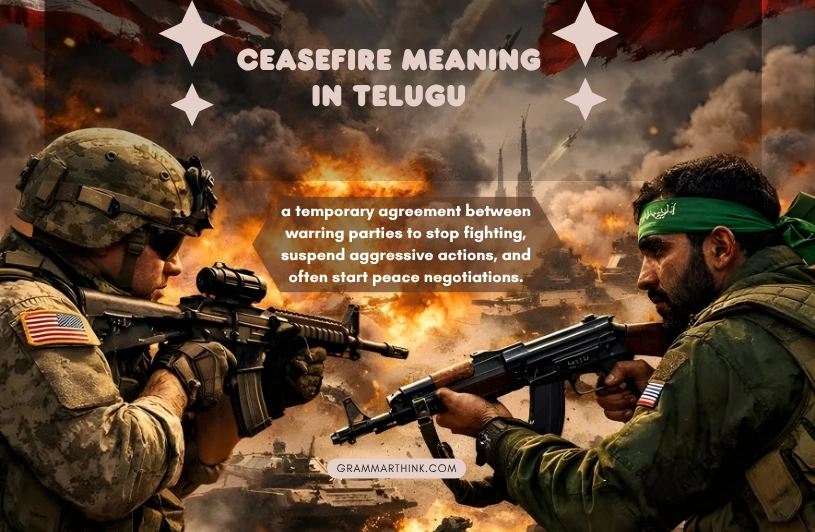
Ceasefire Meaning In Telugu is యుద్ధవిరమణ (Yuddha Viramaṇa) a compound word where yuddha means war/battle and viramaṇa means stopping or halting. It refers to a formal or informal agreement between opposing forces to stop fighting, either temporarily or permanently.
Quick Stats: Ceasefire Meaning In Telugu
| Feature | Details |
|---|---|
| Telugu Word | యుద్ధవిరమణ (Yuddha Viramaṇa) |
| Literal Translation | War + Stopping |
| Part of Speech | Noun |
| Script | Telugu (Abugida script) |
| Language Family | Dravidian |
| Speakers of Telugu | ~96 million (2025 estimate) |
| English Origin | Middle English / Latin cessare |
| First Recorded Use (English) | 1847, during U.S.-Mexico War |
| Synonyms in Telugu | కాల్పుల విరమణ, శాంతి ఒప్పందం |
| Related Hindi Term | युद्धविराम (Yuddha Viraam) |
Disclaimer: The information provided in this article is for educational and informational purposes only. Translations and linguistic explanations are based on established dictionaries and verified sources. Language usage may vary by region and dialect. For official or legal translation needs, please consult a certified professional.
What Exactly Is the Ceasefire Meaning In Telugu?
Let’s keep this simple.
Ceasefire Meaning In Telugu translates to యుద్ధవిరమణ, pronounced as Yuddha Viramaṇa. Break it down and you get two Telugu words doing all the heavy lifting yuddha (యుద్ధ) meaning “war” or “battle,” and viramaṇa (విరమణ) meaning “cessation” or “stopping.”
Put them together, and you have a word that carries enormous weight the end of guns firing, bombs dropping, and soldiers charging.
But here’s what most translation articles skip: Telugu also uses కాల్పుల విరమణ (Kalpula Viramaṇa) more commonly in journalism and news broadcasts. Kalpula refers specifically to “gunfire” or “firing,” making kalpula viramaṇa literally “stopping of gunfire.” You’ll see this in Telugu newspapers like Eenadu and Sakshi almost every time there’s a conflict in the news.
Both terms are correct. Context and register determine which one you use.
A Grammatical Overview
Understanding the grammar behind Ceasefire Meaning In Telugu helps you use the word correctly, not just recognize it.
యుద్ధవిరమణ is a samasa (compound word) a feature of Telugu that combines two or more roots into one meaningful unit. This is common in Dravidian languages and creates precision without needing extra words.
| Grammar Element | Telugu | Transliteration |
|---|---|---|
| Noun (base form) | యుద్ధవిరమణ | Yuddha Viramaṇa |
| Verb form (to cease fire) | కాల్పులు ఆపు | Kalpulu Aapu |
| Adjective (ceasefire deal) | యుద్ధవిరమణ ఒప్పందం | Yuddha Viramaṇa Oppandam |
| Plural / general use | యుద్ధవిరమణలు | Yuddha Viramaṇalu |
In Telugu, nouns change form based on grammatical case. యుద్ధవిరమణ follows the standard neuter/abstract noun pattern.
Origin & Etymology: Where Did “Ceasefire” Even Come From?
The English word ceasefire has a fascinating paper trail.
It combines two Old French-derived words: cesser (to cease, from Latin cessare, meaning “to stop”) and fire (referring to the firing of weapons). The compound form ceasefire appeared in written English around 1847, during the Mexican-American War.
In Telugu, the equivalent grew organically from classical Sanskrit and native Dravidian roots. Yuddha (युद्ध in Sanskrit) is a loanword from Sanskrit, deeply embedded in Telugu literature and scriptures. Viramaṇa comes from the Telugu-Sanskrit root viram, meaning “pause” or “rest.”
This makes Ceasefire Meaning In Telugu a fascinating linguistic bridge English drawing from Latin, Telugu drawing from Sanskrit, both landing on essentially the same concept across entirely different civilizational traditions.
Definition in Multiple Indian Languages
Because this topic naturally extends to regional language learners, here’s a clean breakdown of ceasefire meaning across major Indian languages.
| Language | Word / Phrase | Transliteration |
|---|---|---|
| Telugu | యుద్ధవిరమణ | Yuddha Viramaṇa |
| Hindi | युद्धविराम | Yuddha Viraam |
| Urdu | جنگ بندی | Jang Bandi |
| Marathi | युद्धबंदी / शस्त्रसंधि | Yuddhabandi / Shastrasamdhi |
| Punjabi | ਜੰਗਬੰਦੀ | Jangbandi |
| Kannada | ಕದನ ವಿರಾಮ | Kadana Virāma |
Ceasefire Meaning In Hindi युद्धविराम — (Yuddha Viraam) is probably the most widely recognized across North India. Ceasefire Meaning In Urdu جنگ بندی (Jang Bandi) is used heavily in Pakistani and Indian Urdu media, especially around Kashmir-related coverage.
Ceasefire Meaning In Marathi uses two variations: yuddhabandi (more colloquial) and shastrasamdhi (more formal, used in legal/political documents).
Ceasefire Meaning In Punjabi — ਜੰਗਬੰਦੀ (Jangbandi) is the dominant term in Punjab-region journalism.
Ceasefire Meaning In Kannada — ಕದನ ವಿರಾಮ (Kadana Virāma) where kadana means “battle” and virāma means “pause.” Structurally similar to Telugu, which makes sense given the shared Dravidian linguistic lineage.
Different Contexts Where Ceasefire Is Used
The ceasefire meaning definition shifts subtly depending on context. Here’s where it matters most:
1. Military & Warfare Context
This is the classic use two armed forces agree (or are ordered) to stop shooting. A ceasefire meaning here is a tactical pause, not necessarily peace.
2. Diplomatic / Political Context
In international diplomacy, a ceasefire is often a precondition for peace talks. The full and immediate ceasefire meaning in UN resolutions (like UNSC Resolution 2735 of 2024) typically signals a demand for zero delay in stopping hostilities no gradual wind-down.
3. Legal & Humanitarian Context
When humanitarian law refers to ceasefires, it usually involves civilian protection zones and medical access. A total ceasefire meaning in this context means all forms of violence stop not just front-line shooting, but airstrikes, drone attacks, and blockades.
4. Informal / Colloquial Use
People use “ceasefire” casually too between arguing siblings, rival businesses, or sports teams. In Telugu conversation, you might hear “మనం ఒక చిన్న యుద్ధవిరమణ చేసుకుందాం” “Let’s call a small ceasefire.”
Synonyms & Antonyms in Telugu
Synonyms (Same or Similar Meaning)
| Telugu | Transliteration | Meaning |
|---|---|---|
| కాల్పుల విరమణ | Kalpula Viramaṇa | Cessation of gunfire |
| శాంతి ఒప్పందం | Shanti Oppandam | Peace agreement |
| యుద్ధ విరతి | Yuddha Virati | War truce |
| సంఘర్షణ విరమణ | Sangharshana Viramaṇa | Conflict cessation |
Antonyms (Opposite Meaning)
| Telugu | Transliteration | Meaning |
|---|---|---|
| యుద్ధ ప్రారంభం | Yuddha Prarambham | Start of war |
| సంఘర్షణ | Sangharshana | Conflict / confrontation |
| దాడి | Daadi | Attack / assault |
| యుద్ధం తిరిగి ప్రారంభించడం | Yuddham Tirigi Prarambhinchadam | Resumption of war |
Example Sentences
Real sentences ground the meaning. Here are practical examples showing Ceasefire Meaning In Telugu used in various forms.
1. News-style sentence:
“రెండు దేశాల మధ్య యుద్ధవిరమణ అమలులోకి వచ్చింది.” (The ceasefire between the two countries has come into effect.)
2. Violation context (Violates Ceasefire Meaning):
“ఒక వర్గం కాల్పుల విరమణను ఉల్లంఘించిందని ఆరోపణలు వచ్చాయి.” (Allegations have emerged that one party violated the ceasefire.)
3. Full and immediate ceasefire usage:
“అంతర్జాతీయ సమాజం పూర్తి మరియు తక్షణ యుద్ధవిరమణ కోసం పిలుపు ఇచ్చింది.” (The international community called for a full and immediate ceasefire.)
4. Total ceasefire context:
“సంపూర్ణ యుద్ధవిరమణ లేకుండా శాంతి చర్చలు సాధ్యం కాదు.” (Peace talks are not possible without a total ceasefire.)
5. Colloquial use:
“పిల్లలు గొడవ ఆపి ఒక యుద్ధవిరమణకు అంగీకరించారు.” (The children stopped fighting and agreed to a ceasefire.)
What “Violates Ceasefire” Means And Why It Matters
The phrase violates ceasefire meaning comes up constantly in international news.
To violate a ceasefire means one party after agreeing to stop resumes hostile actions. This could be direct gunfire, aerial bombing, or even cyber attacks depending on the agreement’s scope.
In Telugu media, this is reported as: “యుద్ధవిరమణ ఉల్లంఘన” (Yuddha Viramaṇa Ullanghana) where ullanghana means “violation” or “breach.”
Warning most articles skip: A ceasefire violation doesn’t automatically restart a war. International law under the Geneva Conventions (Article 17, 1949) distinguishes between technical violations (accidental border fire) and material breaches (deliberate resumption of hostilities). The difference matters enormously in diplomatic consequences.
Full and Immediate vs. Total Ceasefire What’s the Difference?
These two phrases sound the same. They’re not.
| Term | What It Means |
|---|---|
| Full and Immediate Ceasefire | All fighting must stop NOW — no delay, no phased approach. Used in urgent UN resolutions. |
| Total Ceasefire | All forms of violence stop — including indirect attacks (blockades, drone surveillance strikes, economic warfare). Broader in scope. |
| Temporary Ceasefire | A limited-time pause, often for humanitarian corridors. Not a permanent peace. |
| Bilateral Ceasefire | Both sides agree mutually. Most common formal type. |
| Unilateral Ceasefire | One side stops fighting without the other’s formal agreement. Often used as a diplomatic gesture. |
In Ceasefire Meaning In Telugu, all these distinctions translate with added adjectives:
- Full and immediate = పూర్తి మరియు తక్షణ
- Total = సంపూర్ణ
- Temporary = తాత్కాలిక
Expert Insight: Why Telugu Uses Two Different Terms
Here’s something linguists find genuinely interesting about Ceasefire Meaning In Telugu.
Telugu journalism gravitates toward కాల్పుల విరమణ because it’s more visceral and specific kalpulu (gunfire) is concrete. Readers picture bullets stopping.
Political and legal Telugu texts prefer యుద్ధవిరమణ because yuddha (war) is broader and more formal. It covers the full spectrum of conflict, not just gunfire.
This dual-term usage mirrors a pattern seen in other Dravidian languages too Kannada uses both kadana virāma (battle-pause) and shashtra virati (weapons-rest) depending on register.
The takeaway: When reading Telugu news, context tells you which term to expect. War correspondent reports = kalpula viramaṇa. UN coverage = yuddha viramaṇa.
Related Terms Worth Knowing
| Term | Telugu | Meaning |
|---|---|---|
| Peace Treaty | శాంతి ఒప్పందం | Formal agreement ending conflict |
| Armistice | శస్త్ర సంధి | Longer-term suspension of fighting |
| Truce | యుద్ధ విరతి | Informal temporary stoppage |
| Demilitarized Zone | నిరాయుధీకరణ జోన్ | Area where weapons are banned |
| Peace Talks | శాంతి చర్చలు | Negotiations toward ending conflict |
Pros and Cons of a Ceasefire Agreement
| Pros | Cons |
|---|---|
| Stops immediate casualties | May freeze conflicts without resolving root causes |
| Opens space for humanitarian aid | Can be used tactically to rearm |
| Required for diplomatic negotiations | Difficult to monitor and enforce |
| Reduces civilian suffering | Violations often go unpunished |
| International legitimacy signal | May embolden the stronger party |
Read Also: Introvert Meaning In Marathi
Conclusion
The Ceasefire Meaning In Telugu యుద్ధవిరమణ (Yuddha Viramaṇa) is more than a dictionary entry. It’s a word that carries the weight of silence after warfare, of agreements made under pressure, and of millions of ordinary people hoping the guns finally stop.
Whether you’re a Telugu language learner, a student of international relations, or simply trying to understand what that news anchor just said on TV9 Telugu, knowing the difference between yuddha viramaṇa and kalpula viramaṇa and when each appears gives you a sharper understanding of how conflict is reported in South India.
The ceasefire meaning definition across Telugu, Hindi, Urdu, Marathi, Punjabi, and Kannada shares one common thread: the word always signals hope, however fragile, that the fighting has paused.
Key Takeaways:
- Ceasefire Meaning In Telugu = యుద్ధవిరమణ or కాల్పుల విరమణ
- Telugu journalism uses kalpula viramaṇa; formal/legal contexts use yuddha viramaṇa
- Full and immediate ceasefire meaning = urgent, no-delay halt to all hostilities
- Total ceasefire meaning = complete halt including indirect and economic warfare
- Violates ceasefire meaning = one party resumes hostilities after agreeing to stop
- The word has Sanskrit roots (yuddha) merged with Dravidian roots (viramaṇa)
? Frequently Asked Questions
Q1. What is the exact Ceasefire Meaning In Telugu?
యుద్ధ విరమణ (Yuddha Viramaṇa) literally “the stopping of war.” Used in Telugu political, military, and news contexts.
Q2. Is ceasefire the same as peace?
No. A ceasefire pauses fighting. A peace treaty legally ends it. One can collapse overnight; the other is binding under international law.
Q3. What is Ceasefire Meaning In Hindi?
युद्ध विराम (Yuddha Viraam). Same Sanskrit root as Telugu both use Yuddha for war.
Q4. What does “violates ceasefire” mean?
When one or both sides break the agreed halt by resuming gunfire, airstrikes, or unauthorized troop movement.
Q5. How is Ceasefire Meaning In Urdu different from Telugu?
Urdu uses جنگ بندی (Jang Bandi) Persian/Arabic roots. Telugu uses Sanskrit roots. Same meaning, completely different linguistic origin.
Q6. What is Full And Immediate Ceasefire Meaning?
All fighting stops completely, right now, by all parties no conditions, no delays, no exceptions.
Q7. What is Ceasefire Meaning In Kannada?
ಕದನ ವಿರಾಮ (Kadana Virāma). Close in structure to Telugu since both are Dravidian languages.
Q8. Can a ceasefire be one-sided?
Yes but it rarely holds. If the other side keeps firing, it is not a ceasefire. It is just one group choosing not to shoot back.
