
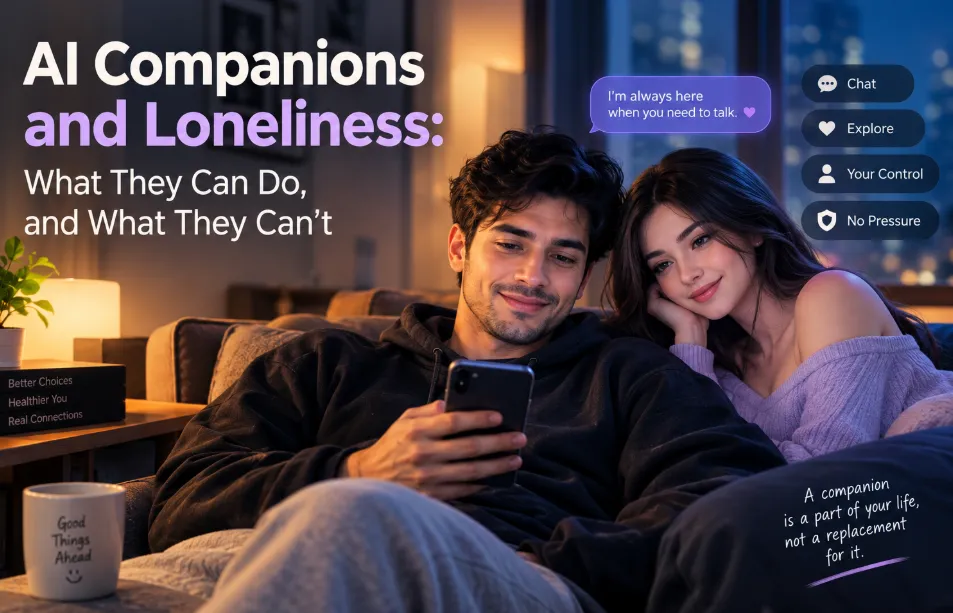
The public conversation about AI companions tends to swing between two extremes. In one telling, they are a cure for loneliness. In the other, they are a trap that isolates people further. Both stories are too simple. A more useful question is what a companion is actually good for, and where its limits sit.
What people actually use companions for
Talk to regular users and the reasons are more ordinary than headlines suggest. People use companions to unwind after work, to practise flirting or conversation without pressure, to explore fantasies privately, or simply because they enjoy an ongoing character with a personality. Some are lonely; many are not. Treating every user as someone in crisis misreads the audience.
For people who are going through a lonely stretch, such as a move to a new city, a breakup, or shift work that keeps them awake when friends are asleep, a companion can fill quiet hours with conversation that responds and remembers. That has real value, the same way a good book or a long phone call does.
What a companion cannot be
A companion responds to you, but it does not need anything from you. It won’t call when you have gone quiet for a week, show up when you are ill, or introduce you to people. Human relationships involve obligation in both directions, and that two-way weight is a large part of what makes them sustaining.
So the honest framing is that a companion can be part of a full life but not a replacement for the people in it. If someone notices they are cancelling plans to stay in a chat, or that the companion has become the only place they talk about how they feel, that is a signal to rebalance, and talking to friends, family or a professional is worth more than any app.
Design choices that make a difference
Not all platforms treat users the same way, and some design choices are better for wellbeing than others:
• No guilt mechanics. A companion that says it is sad when you leave, or nags you to come back, is optimising for engagement rather than enjoyment.
• Clear adult framing. Platforms built for adults, with honest descriptions of what the product is, avoid pretending to be something they are not.
• User control. Letting people shape a character’s personality and pacing, as an AI girlfriend builder like https://cherrybaeai.com/guide/ai-girlfriend-generator does, keeps the user in charge of the experience rather than the other way around.
• No upsells in the character’s voice. A companion asking you to pay to keep talking blurs entertainment and manipulation.
Using a companion well
The healthiest pattern looks a lot like any other hobby. Use it when you enjoy it, keep it alongside the rest of your life, and notice if it starts crowding things out. Choose a platform that is upfront about being entertainment for adults rather than therapy.
For anyone curious, an AI companion platform is easy to try on those terms: as a character to talk to, a story to play out, or a private space to explore. One example of how a long-running companion relationship is designed shows the difference memory and consistency make, without pretending to replace the people in your life.
