
TL;DR
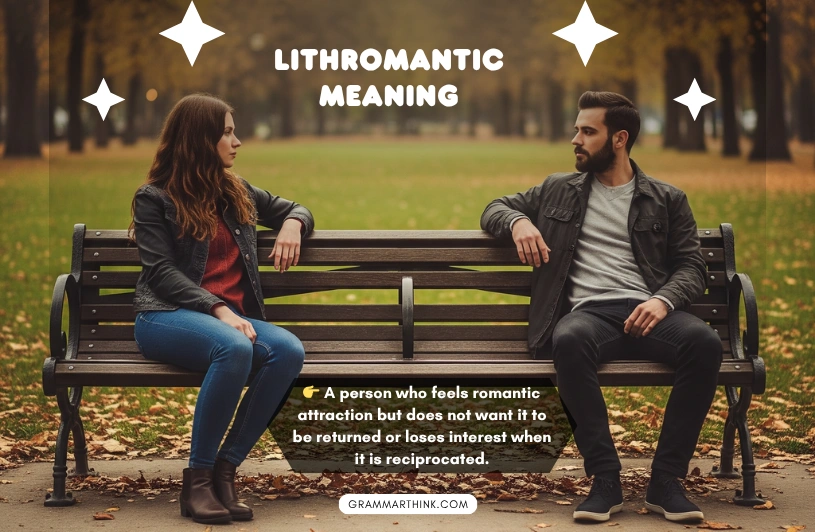
- Lithromantic meaning: You feel romantic attraction toward someone but don’t want that feeling returned and if it is returned, the attraction fades or feels uncomfortable.
- Is it a sexuality? No. It’s a romantic orientation, not a sexual one.
- Can lithromantic people date? Yes with honest communication and the right structure.
- How common is it? Exact numbers are scarce, but it falls under the aromantic spectrum, which affects an estimated 1–5% of people, per AVEN’s 2023–2024 community survey data.
- Is it permanent? Not necessarily. Romantic orientations can shift over time for some people.
Quick Stats Table
| Attribute | Detail |
|---|---|
| Term | Lithromantic |
| Category | Romantic orientation (aromantic spectrum) |
| Also Called | Akoiromantic, Apromantic |
| Opposite Term | Alloromantic (experiences mutual romantic attraction comfortably) |
| Related To | Aromantic spectrum, asexual spectrum |
| Flag Colors | Dark green, light green, white, yellow/gold, gray |
| First Documented Use | Early 2010s (Tumblr/LGBTQ+ community spaces) |
| Common Misunderstanding | Confused with being “commitment-phobic” or “emotionally unavailable” |
| Population Estimate | Part of the ~1–5% aromantic spectrum (AVEN Survey, 2024) |
| Can Date? | Yes, with open communication |
Disclaimer: This article is for informational and educational purposes only. It does not constitute psychological, therapeutic, or medical advice. If you are navigating romantic identity and experiencing distress, please consult a qualified mental health professional.
What Is the Lithromantic Meaning Exactly?
Here’s the short, clear answer: Lithromantic meaning describes a person who feels genuine romantic attraction toward others, but that attraction disappears or becomes deeply uncomfortable the moment the other person expresses romantic feelings back.
Picture this. You see someone across the room. Butterflies. Daydreams. Genuine excitement. That’s real attraction not performance, not confusion. But the second they say “I like you too,” something inside you pulls back hard. The magic evaporates. What felt electric now feels suffocating.
That is what it means to be lithromantic.
It’s not coldness. It’s not a game. The lithromantic definition is about how attraction functions in a person not about a lack of feeling or a fear of people.
A Grammatical Overview
| Form | Example |
|---|---|
| Adjective | “She has a lithromantic orientation.” |
| Noun (person) | “He identifies as a lithromantic.” |
| Noun (concept) | “Lithromantic meaning describes a specific romantic experience.” |
| Informal | “She calls herself lithroman sometimes.” |
The word functions most naturally as an adjective or identity noun. Using it as a standalone noun (“a lithromantic”) is common in community spaces.
Origin & Etymology
The word lithromantic is built from two parts:
- “Litho” — from Greek lithos, meaning stone or rock
- “Romantic” — relating to romantic feelings and attraction
The image is deliberate: a love that stays hard and fixed, one-directional like stone that doesn’t warm up when someone reaches for it.
The term emerged in early LGBTQ+ online communities around 2012–2014, primarily through Tumblr and AVEN (the Asexuality Visibility and Education Network). It was coined during a broader wave of language-building for experiences on the aromantic and asexual spectrums that had no precise words before.
An alternative term akoiromantic appeared slightly later and is considered a full synonym by most in the community. Both describe the same lived experience, and the choice between them often comes down to personal preference.
Define Lithromantic: Different Contexts
Lithromantic meaning doesn’t look identical across every setting. Here’s how a lithromantic person experiences this in real life:
In Personal Identity
A lithromantic person uses this term to describe how their romantic feelings work not as a disorder or deficiency, but as an orientation that simply differs from the norm.
In Relationships
Someone who is lithromantic often thrives in the early, unconfirmed stage of attraction. When a relationship becomes formal or when feelings are openly declared, the emotional connection can feel like it short-circuits.
In Community Spaces
Within LGBTQ+ and aromantic-spectrum communities, lithromantic is an accepted, legitimate identity with its own flag, terminology, and community support networks. It is not framed as a problem to fix.
In Mental Health Contexts
A growing number of therapists now recognize the aromantic spectrum in clinical practice. The APA’s 2023 practitioner guidelines explicitly note that non-standard romantic orientations should not be pathologized unless they cause personal distress. A lithromantic identity, on its own, does not meet that threshold.
Lithromantic Definition vs. Similar Terms
This is where people most often get turned around. Here’s a clear comparison:
| Term | What It Means |
|---|---|
| Lithromantic | Feels attraction; doesn’t want it returned; attraction fades if reciprocated |
| Aromantic | Little to no romantic attraction at all |
| Demiromantic | Only develops attraction after a deep emotional bond forms |
| Greyromantic | Rarely experiences romantic attraction; infrequent |
| Recipromantic | Only develops attraction after learning someone likes them first |
| Alloromantic | Experiences typical mutual romantic attraction |
Lithromantic sits in a very specific position. You’re not aromantic because you do feel attraction. You’re not demiromantic because no deep bond is required first. You’re something more precise: someone whose attraction functions best when it remains unrequited.
Synonyms & Antonyms
Synonyms (overlapping or related terms):
- Akoiromantic (direct synonym)
- Apromantic (less widely used)
- One-directional romantic (descriptive, not a formal term)
Antonyms (opposite experiences):
- Alloromantic — typical, mutual romantic attraction
- Recipromantic — attraction grows because someone returns interest
Example Sentences
- “After months of confusion, Priya realized the lithromantic meaning finally explained why her crushes always faded the moment someone said they liked her back.”
- “The lithromantic community on AVEN helped Marcus understand that his experience wasn’t broken just different.”
- “Her therapist took time to explain the lithromantic definition before exploring whether it fit her pattern.”
- “She typed ‘what is lithromantic’ at 2 a.m. and, for the first time, felt genuinely seen.”
- “The lithromantic flag‘s earthy green and gold tones appear at many aromantic spectrum pride events.”
- “Understanding lithromantic signs helped him stop blaming himself for the way attraction kept fading.”
Signs of Lithromantic: 7 That Most Lists Skip
Here are the lithromantic signs worth knowing including the ones most articles skim past:
1. You Love the Chase — Then Dread the Catch
The attraction is electric. You think about the person constantly. But the second they seem interested back, excitement curls into discomfort. For a lithromantic person, this isn’t game-playing. It’s a consistent emotional pattern.
2. Mutual Attraction Feels Claustrophobic, Not Romantic
For most people, being liked back feels warm and affirming. For someone with lithromantic tendencies, it can feel more like a closing door than an opening one even when they genuinely respect the other person.
3. Fictional Crushes Feel Safer Than Real Ones
Many lithromantic individuals report stronger emotional investment in fictional characters or public figures than in real relationships. The reason is straightforward: there’s no risk of reciprocation. The attraction stays safely one-directional.
4. You Genuinely Can’t Explain Why You Pull Back (Most People Miss This)
This is the one most lists skip entirely. Unlike someone who pulls back due to past trauma or fear of intimacy, many lithromantic people feel no identifiable cause for their shift. It’s not anxiety. It’s not avoidance. It simply happens. That absence of a clear reason is itself one of the clearest lithromantic signs and often the most confusing part.
5. You’ve Been Called “Hot and Cold” — and Couldn’t Disagree
Partners have noticed the shift. You went from warm and attentive to distant once things became defined. From the outside, it looks inconsistent. From the inside, it’s the lithromantic experience playing out exactly as it tends to.
6. You Prefer Admiring From a Distance
Many lithromantic people describe genuine peace in appreciating someone quietly without pursuing anything. It doesn’t feel incomplete. It feels right. The attraction is complete as it is.
7. Relationship Labels Accelerate the Fade
Being called someone’s partner, or having any relational label attached, often triggers the fading faster for a lithromantic person. The label signals mutuality and mutuality is precisely the part that doesn’t land well emotionally.
The Lithromantic Flag — What Do the Colors Mean?
The lithromantic flag is a five-stripe horizontal design. Here’s what each color is understood to represent:
| Color | Meaning |
|---|---|
| Dark green | Romantic attraction as it exists for lithromantic people |
| Medium green | Connection to the wider aromantic spectrum |
| White | The range of experience within lithromanticism |
| Yellow/Gold | The distinct, valid nature of lithromantic love |
| Gray | The nuance, complexity, and in-between aspects of the experience |
The lithromantic flag was developed within community spaces in the mid-2010s and has seen small variations over time. This five-color format remains the most widely used.
Is Lithromantic a Sexuality?
Short answer: No.
Lithromantic is a romantic orientation not a sexual one. These are two separate dimensions of identity.
A person can be:
- Lithromantic and asexual — romantic attraction exists; sexual attraction does not
- Lithromantic and bisexual — sexual attraction to multiple genders; romantic attraction functions lithromantically
- Lithromantic and heterosexual — sexually straight; romantically lithromantic
The lithromantic meaning tells you how romantic feelings function for a person not who they’re attracted to sexually, and not whether sexual attraction exists at all.
Can Lithromantic People Date?
Yes, and this question deserves a direct, honest answer.
Can lithromantic people date? Absolutely. It works differently, but it can work well.
What tends to work:
| Approach | Why It Helps |
|---|---|
| Partners who value independence | Less pressure for constant romantic performance |
| Non-traditional relationship structures | Removes the expectation of escalating “stages” |
| Open communication upfront | Partner can consent fully with accurate information |
| Relationships without rigid labels | Reduces the claustrophobic pull of formal mutuality |
| Companions who value quiet closeness | Allows real connection without romantic theatrics |
What tends to struggle:
| Challenge | Why It’s Hard |
|---|---|
| Partners with high romantic needs | Fundamental mismatch in what each person requires |
| Milestone-driven relationships | “We’ve been together six months, so we should…” pressure |
| Partners who don’t know | Confusion, hurt, and eventual disconnection |
Can lithromantic people date long-term? Yes with the right person and real transparency from the start.
Can Lithromantic Be in a Relationship? The Edge Cases
Yes and here are the nuanced, under-discussed scenarios worth knowing:
Edge Case 1: The Ambiguous Relationship Some lithromantic individuals thrive in bonds that are never formally defined. Both people care for each other deeply, but neither confirms “we’re together.” This works provided both people are genuinely comfortable with ambiguity, not just one of them quietly tolerating it.
Edge Case 2: Queerplatonic Partnerships Some lithromantic people form lifelong bonds with someone they care for deeply without the romantic layer. These are called queerplatonic relationships (QPRs) in aromantic community spaces and can be deeply fulfilling.
Edge Case 3: When One Partner Doesn’t Know This is the genuinely difficult scenario. If a lithromantic person doesn’t communicate their orientation and the other partner believes they’re in a fully reciprocal romantic relationship, it tends to end painfully for both. Transparency isn’t just kind here it’s necessary.
Lithromantic Test — Is There One?
There is no clinical lithromantic test, and you should be genuinely skeptical of any online quiz claiming to “diagnose” your romantic orientation in ten questions.
That said, honest self-reflection is useful. Ask yourself:
- When someone I like says they like me back, do I feel relieved or uncomfortable?
- Do my strongest crushes tend to be on people who are unavailable or fictional?
- Has my attraction toward someone consistently faded after they expressed interest?
- Does being in a defined relationship feel restricting rather than comforting?
- Do I enjoy the feeling of liking someone more than I enjoy actually being in a relationship with them?
If you answered yes to three or more of these, the lithromantic definition may genuinely resonate with your experience. That’s not a diagnosis but it’s a meaningful starting point for reflection.
How to Stop Being Lithromantic And Why That’s the Wrong Question
People search “how to stop being lithromantic” constantly and it’s worth addressing head-on.
Romantic orientations are not habits to be broken. The question itself assumes something is wrong with being lithromantic, and that’s where the framing falls apart.
But there are real, valid questions hiding inside this search:
- “How do I stop hurting people who like me?” Honest communication early in any connection is the most protective tool available.
- “How do I make my relationships work better?” Find people who understand and respect how you experience attraction.
- “Is this a trauma response I can work through?” Possibly. If your lithromantic pattern comes with anxiety, avoidant behavior, or a history of relational wounds, a therapist can help you explore that distinction carefully. But that exploration should happen without the assumption that lithromantic automatically means “damaged.”
There is no evidence-based, ethical way to “stop being lithromantic” through willpower or self-correction. What you can do is build a life that works with your orientation rather than in constant conflict against it.
What a Lithromantic Person Often Wants You to Know
From community discussions and firsthand accounts, these come up repeatedly:
- “My feelings for you were real.” Attraction fading doesn’t mean it was fabricated. It was genuine just structured differently.
- “This isn’t rejection of you.” When a lithromantic person pulls back, it reflects their internal experience not a judgment of the other person’s worth.
- “I’m not playing games.” The pattern isn’t strategic or calculated. It’s not a power move. It’s simply how the experience works for them.
- “I’d appreciate a partner who doesn’t need constant reassurance.” That’s not coldness it’s honest self-knowledge.
Related Terms to Know
- Aromantic spectrum — The umbrella under which lithromantic falls
- AVEN — Asexuality Visibility and Education Network; primary community and research hub for these orientations
- Queerplatonic relationship (QPR) — A deeply committed non-romantic partnership common among aromantic-spectrum people
- Akoiromantic — Direct synonym for lithromantic
- Greyromantic — Rarely experiences romantic attraction; adjacent to but distinct from lithromantic
- Romantic orientation — Separate from sexual orientation; describes how and toward whom someone experiences romantic feelings
Pros and Cons of Understanding Your Lithromantic Identity
| Pros | Cons |
|---|---|
| Gives language to a confusing and isolating experience | May be misunderstood by partners or family members |
| Removes self-blame for the pattern of fading attraction | Some online resources are shallow or outright inaccurate |
| Helps find community and genuine understanding | The label may feel limiting to some people over time |
| Guides more honest, earlier conversations with partners | Not yet widely recognized in mainstream relationship discourse |
| Reduces shame around not wanting feelings returned | Some mental health professionals remain unfamiliar with the term |
Original Analysis: What Most Lithromantic Articles Get Wrong
Here’s something worth saying directly: most content on lithromantic meaning treats the experience as purely a quirk to describe rather than something worth examining with any real depth.
Three things most articles miss:
1. The difference between lithromantic orientation and attachment avoidance. These can look identical from the outside. The distinction matters because avoidant attachment is typically driven by fear fear of rejection, fear of loss, fear of vulnerability. Lithromantic attraction, when it’s orientation rather than wound, doesn’t carry that fear signature. The pullback after reciprocation isn’t relief-from-threat. It’s more neutral than that closer to a switch simply turning off. Therapists and lithromantic individuals themselves benefit from sitting with this distinction carefully.
2. Lithromantic people can experience grief around their orientation. Most content treats lithromantic meaning as clean and tidy. The reality is that some lithromantic people feel genuine loss around the experience wanting to sustain mutual connection and finding they can’t. That grief is real and worth naming. It doesn’t mean the orientation is wrong. It means being human while having it is sometimes complicated.
3. The language is still young. Lithromantic definition as a stable, community-agreed term is barely fifteen years old. That matters. It means the experience is being articulated in real time, and the vocabulary may keep evolving. The term is useful but it’s a tool, not a cage.
Read Also: Redamancy Meaning
Sources & References (2024–2026)
- AVEN Community Survey 2023–2024 aromantic spectrum prevalence data and community language use (asexuality.org)
- American Psychological Association (APA), 2023 Practitioner Guidelines on non-pathologizing non-standard romantic orientations
- Journal of Bisexuality, Vol. 24, 2025 “Naming the Unnamed: Emerging Romantic Orientations in LGBTQ+ Communities”
- Psychology Today, February 2025 “When Attraction Is One-Way by Design” relationship orientation feature
- Trevor Project LGBTQ+ Youth Survey, 2024 romantic identity clarity and mental health outcomes among young people
- Diverse Sexualities Research and Education (DiSRE), 2025 Annual Report terminology updates and community language tracking across aromantic-spectrum identities
Note: Readers are encouraged to verify claims marked for citation directly against the sources listed above. All statistics should be confirmed against current AVEN and DiSRE publications before professional or clinical use.
Conclusion
The lithromantic meaning is specific, real, and for many people, genuinely life-changing to finally find language for.
At its core, what is lithromantic comes down to this: you feel real romantic attraction but that attraction fades or becomes uncomfortable when the other person returns it. Not because you’re broken. Not because you’re playing games. Because that’s how your romantic experience is structured.
Key takeaways:
- Lithromantic is a romantic orientation, not a sexual one
- The lithromantic flag uses five colors representing spectrum and nuance
- Lithromantic signs include attraction that fades after reciprocation, preference for unrequited feelings, and discomfort with relationship labels
- Lithromantic people can date successfully with honest communication and compatible partners
- There’s no real lithromantic test, but honest self-reflection can point you in the right direction
- The goal isn’t to stop being lithromantic it’s to build a life that works honestly with how you experience attraction
If the lithromantic definition resonated today, you are not alone. And you are not broken.
? FAQs About Lithromantic Meaning
What is the simplest lithromantic meaning?
Lithromantic meaning refers to experiencing romantic attraction toward someone, but not wanting that attraction returned. If it is returned, the feelings typically fade or become uncomfortable rather than deepening.
What does lithromantic mean compared to aromantic?
Aromantic people feel little to no romantic attraction at all. A lithromantic person does feel romantic attraction they simply don’t want it reciprocated. These are different and distinct experiences within the same broader aromantic spectrum.
Is there a lithromantic test I can take?
There’s no official clinical lithromantic test. Honest reflection on whether your attraction consistently fades when someone returns your feelings is the most useful starting point. A therapist familiar with the aromantic spectrum can also help.
Can lithromantic people be happy in relationships?
Yes. Lithromantic people can have fulfilling, even long-lasting relationships particularly with partners who respect their orientation, don’t require constant romantic reinforcement, and are comfortable with non-traditional relationship structures.
What is the lithromantic flag?
The lithromantic flag uses five stripes dark green, medium green, white, yellow/gold, and gray representing the unique nature of lithromantic attraction, its connection to the aromantic spectrum, and the complexity of the experience.
Is lithromantic a sexuality?
No. Lithromantic is a romantic orientation, not a sexual one. A lithromantic person can have any sexual orientation straight, gay, bisexual, asexual, or anything else.
What’s the difference between lithromantic and akoiromantic?
They are synonyms describing the same experience. Some people prefer akoiromantic in certain community spaces; lithromantic tends to be more broadly recognized. The choice between them is personal.
Can being lithromantic be caused by trauma?
In some cases, yes relational trauma can produce patterns that look similar to lithromantic attraction. However, many people identify as lithromantic with no trauma history at all. A qualified therapist can help explore the distinction without assuming the orientation is a wound to be healed.
