
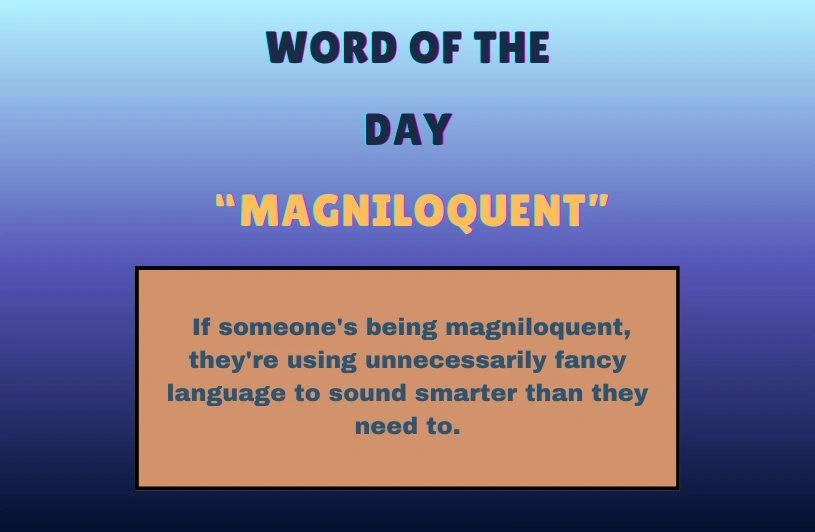
Magniloquent meaning refers to speaking or writing in a pompous, grandiose, or bombastic manner using big, fancy words to sound impressive rather than communicating clearly.
Last Updated: January 21, 2026
Quick Facts: Magniloquent
| Aspect | Details |
|---|---|
| Word | Magniloquent |
| Pronunciation | mag-NIL-uh-kwent |
| Part of Speech | Adjective |
| Origin | Latin: “magnus” (great) + “loqui” (to speak) |
| First Known Use | Early 1600s |
| Primary Meaning | Using pompous, lofty, or grandiose language |
| Connotation | Generally negative (implies pretentiousness) |
| Common Synonyms | Bombastic, pompous, grandiloquent, pretentious |
| Common Antonyms | Simple, plain, straightforward, concise |
| Related Words | Grandiloquent, sesquipedalian, verbose, flowery |
| Usage Context | Literature, speech analysis, communication criticism |
| Example Sentence | “The politician’s magniloquent speech impressed no one.” |
Disclaimer
This article focuses on linguistic concepts for educational and entertainment purposes only. Examples are culturally neutral and not intended to offend.
What Does Magniloquent Really Mean? And Why Should You Care?
Imagine you’re at a dinner party, and someone starts talking about having a “refined understanding of the culinary arts.”
Translation? They like good food.
That’s magniloquent meaning in action—the art of using fancy, inflated language when simple words would do just fine. It comes from the Latin words “magnus” (great) and “loqui” (to speak), literally meaning “speaking greatly” or “talking big.”
But here’s the twist: while the word itself sounds impressive, being called magniloquent isn’t exactly a compliment. It’s like someone saying you’re trying too hard to sound smart. Think of it as the verbal equivalent of wearing a tuxedo to a backyard barbecue.
The magniloquent meaning describes speech that’s intentionally lofty, pompous, and overblown. It’s when someone uses five-dollar words where fifty-cent words would work better. Politicians during election season? Often magniloquent. Your college roommate who discovered a thesaurus? Definitely magniloquent.
The History Behind This Big, Fancy Word
The word “magniloquent” strutted into English around the early 1600s, borrowed from Latin “magniloquus.” During the Renaissance, educated folks loved showing off their classical knowledge by peppering conversations with Latin-derived terms.
Ironically, a word criticizing fancy language is itself pretty fancy. That’s the beautiful contradiction of magniloquent meaning it’s a sophisticated term for describing unsophisticated communication habits.
Throughout history, magniloquent speakers have included:
- Victorian-era politicians delivering four-hour speeches
- Lawyers in courtroom dramas using unnecessarily complex legal jargon
- That one friend who says “utilize” instead of “use” in every sentence
Magniloquent vs Grandiloquent: What’s the Actual Difference?
Here’s where things get interesting. People often confuse magniloquent vs grandiloquent, and honestly? They’re kissing cousins in the vocabulary family.
| Aspect | Magniloquent | Grandiloquent |
|---|---|---|
| Core Focus | Lofty, pompous speech | Bombastic, inflated language |
| Etymology | Magnus (great) + loqui (speak) | Grandis (grand) + loqui (speak) |
| Usage Tone | Slightly more neutral | More negative, implies pretension |
| Common Context | Formal speeches, academic writing | Political rhetoric, self-important talk |
When comparing magniloquent vs grandiloquent, think of it this way: magniloquent speakers think they sound impressive. Grandiloquent speakers are actively trying to impress you and failing.
Both describe unnecessarily fancy language, but grandiloquent carries an extra layer of “look how important I am!” Meanwhile, the magniloquent meaning focuses more on the “big words for big words’ sake” aspect.
Magniloquent and Sesquipedalian Meaning: The Dynamic Duo of Wordiness
If you really want to understand pretentious language, you need to know about magniloquent and sesquipedalian meaning together.
Sesquipedalian (from Latin “sesquipedalis,” meaning “a foot and a half long”) describes someone who loves using long, multi-syllable words. Think “antidisestablishmentarianism” when “disagreement” would suffice.
Here’s the relationship between magniloquent and sesquipedalian meaning:
Sesquipedalian = Uses long words
Magniloquent = Uses fancy, pompous language
Sesquipedalian + Magniloquent = Uses long, fancy, pompous words (the ultimate word snob)
You can be sesquipedalian without being magniloquent (like medical professionals using technical terms), and you can be magniloquent without being sesquipedalian (using regular-length fancy words). But when someone’s both? Run.
The connection between magniloquent and sesquipedalian meaning shows us that pretentious language comes in different flavors some people prefer lengthy words, others prefer lofty ones, and some unfortunate souls combine both.
Real-World Examples: Spotting Magniloquent Language in the Wild
Let’s look at some examples to cement that magniloquent meaning in your brain:
Magniloquent version: “I find myself intellectually and emotionally incapacitated to provide assistance in this particular endeavor.”
Normal version: “Sorry, I can’t help with that.”
Magniloquent version: “This establishment’s culinary offerings are exceedingly substandard.”
Normal version: “The food here sucks.”
Magniloquent version: “I shall endeavor to ascertain the veracity of your assertions.”
Normal version: “I’ll fact-check that.”
See the pattern? The magniloquent meaning shines through when simple ideas wear tuxedos made of unnecessary words.
Magniloquent Synonyms: Other Ways to Say “Stop Showing Off”
Understanding magniloquent synonyms helps you recognize this linguistic peacocking in all its forms:
- Bombastic
- Pompous
- Pretentious
- Highfalutin
- Overblown
- Grandiose
- Flowery
- Turgid
- Inflated
- Ostentatious
Each magniloquent synonym captures slightly different flavors of fancy-pants language, but they all point to the same problem: saying more than necessary in fancier ways than required.
Magniloquent Antonyms: The Beautiful Simplicity
If you want to avoid sounding magniloquent, embrace these magniloquent antonyms:
- Simple
- Plain
- Straightforward
- Direct
- Clear
- Concise
- Unpretentious
- Humble
- Down-to-earth
Magniloquent antonyms represent communication that respects your audience’s time and intelligence. They’re the verbal equivalent of a firm handshake versus a elaborate bow.
Magniloquent Meaning Across Languages
Language lovers often wonder about translations. Here’s the magniloquent meaning in various Indian languages:
Magniloquent meaning in Hindi: आडंबरपूर्ण (āḍambarapūrṇa) or बड़बोला (baṛbolā)
Magniloquent meaning in Marathi: भव्य बोलणे (bhavya bolane) or दिखाऊ भाषा (dikhāū bhāṣā)
Magniloquent meaning in Tamil: ஆடம்பரமான பேச்சு (āṭamparamāṉa pēccu)
Magniloquent meaning in Bengali: আড়ম্বরপূর্ণ (āṛambarapūrṇa) or জাঁকজমকপূর্ণ (jām̐kajamaka pūrṇa)
Magniloquent meaning in Malayalam: ആഡംബരപൂർണ്ണമായ (āḍambarapūrṇṇamāya)
Interestingly, most languages have native words for this concept, suggesting that pompous speaking is a universal human trait that cultures everywhere needed to name and shame.
Why Do People Talk This Way? (The Psychology of Fancy Words)
Understanding the magniloquent meaning raises an obvious question: Why would anyone deliberately sound pretentious?
Here are the real reasons people adopt magniloquent speech patterns:
1. Insecurity: They’re overcompensating for feeling less intelligent by using bigger words.
2. Professional conditioning: Lawyers, academics, and politicians often work in fields where magniloquent language is normalized.
3. Habit: They’ve been talking this way so long they don’t realize how they sound.
4. Cultural expectations: Some formal contexts genuinely require elevated language.
5. Showing off: Sometimes people just want to flaunt their vocabulary.
The magniloquent meaning reminds us that communication should connect, not impress. When language becomes a barrier rather than a bridge, you’ve crossed into magniloquent territory.
How to Avoid Sounding Magniloquent
You can sound smart without being magniloquent. Here’s how:
Replace complex phrases with simple ones
Instead of: “utilize” → Use: “use”
Instead of: “at this point in time” → Use: “now”
Instead of: “for the purpose of” → Use: “to”
Ask yourself: Would I say this to a friend at lunch? If not, it’s probably too magniloquent.
Read your writing aloud: Magniloquent language sounds ridiculous when spoken naturally.
Focus on clarity over cleverness: Your goal is understanding, not admiration.
Remember, avoiding magniloquent speech doesn’t mean talking down to people it means respecting them enough to communicate clearly.
Famous Magniloquent Speakers
Some historical figures became famous for their magniloquent tendencies:
William Faulkner: The novelist wrote sentences so complex and flowery that reading him requires stamina and coffee.
Political speeches from the 1800s: Check out any 19th-century political debate they’re masterclasses in magniloquent rhetoric.
Legal documents: Contracts and court filings remain playgrounds for magniloquent language (much to everyone’s frustration).
These examples show that magniloquent communication isn’t always bad sometimes it’s artful. The difference? Intent. Are you using fancy language to express complex ideas beautifully, or to hide simple ideas behind verbal curtains?
The Modern Context: Social Media and Magniloquent Language
Here’s an ironic twist: In our age of tweets and abbreviations, magniloquent language has found new life online.
LinkedIn humble-braggers who post about their “transformative journey of professional actualization” instead of “got a new job.”
Instagram captions that turn breakfast into “a mindful exploration of morning nourishment rituals.”
Corporate jargon that transforms “problem” into “opportunity for dynamic optimization synergies.”
The magniloquent meaning has expanded in the digital age to include buzzwords, corporate speak, and social media pretension. Same pompous energy, different platform.
When Fancy Language Works vs. When It’s Just Magniloquent
| Appropriate Elevated Language | Magniloquent (Unnecessary) |
|---|---|
| Technical terms in specialized fields | Using jargon to confuse non-experts |
| Legal precision in contracts | Unnecessarily complex everyday emails |
| Academic papers (within reason) | Using big words just to sound smart |
| Formal speeches at state events | Pretentious Instagram captions |
| Poetic and literary writing | Business meetings full of buzzwords |
Understanding this distinction helps you appreciate when elevated language serves a purpose versus when it’s just magniloquent showing off.
Conclusion: The Simple Truth About Magniloquent Meaning
The magniloquent meaning teaches us a valuable lesson about communication: bigger isn’t always better. Words exist to connect people, share ideas, and build understanding not to build walls of vocabulary between speaker and listener.
Whether you’re comparing magniloquent vs grandiloquent, exploring magniloquent and sesquipedalian meaning, or just trying to avoid sounding pretentious in your next email, remember this: Good communication makes complex ideas simple, not simple ideas complex.
The most respected communicators from scientists to storytellers master the art of clarity. They understand that true intelligence shows in making complicated concepts accessible, not in making simple concepts sound complicated.
So next time you’re tempted to “utilize” instead of “use,” or to “endeavor to ascertain” instead of “find out,” remember the magniloquent meaning: Sometimes the fanciest thing you can do is keep it simple.
? Frequently Asked Questions
1. What is the simplest magniloquent meaning?
The magniloquent meaning in simplest terms is: using fancy, pompous, or overly grand language when plain words would work better. It’s basically showing off with vocabulary.
2. Is magniloquent always a negative word?
While the magniloquent meaning generally carries negative connotations of being pretentious, it can occasionally be neutral when describing certain formal or literary styles. However, in 90% of cases, calling someone magniloquent isn’t a compliment.
3. What’s the difference between magniloquent vs grandiloquent?
When people ask about magniloquent vs grandiloquent, the distinction is subtle: both describe pompous language, but grandiloquent implies more deliberate self-importance and pretension, while magniloquent focuses more on lofty, elevated speech patterns.
4. Can you use magniloquent in everyday conversation?
Ironically, using “magniloquent” in casual conversation might make you sound… magniloquent! It’s better suited for writing or formal discussions about communication styles. In everyday chat, try “pretentious” or “showing off” instead.
5. How do magniloquent and sesquipedalian meaning relate?
The relationship between magniloquent and sesquipedalian meaning is complementary: sesquipedalian describes using long words specifically, while magniloquent describes using pompous, lofty language generally. You can be one without being the other, though they often overlap.
6. Are there situations where magniloquent language is appropriate?
Yes! Understanding magniloquent meaning helps you recognize when formal, elevated language serves a purpose—like state ceremonies, certain academic writing, or literary prose—versus when it’s just unnecessary showing off in everyday communication.
Check out our previous blog here: [PLUVIOPHILE MEANING IN HINDI]
