
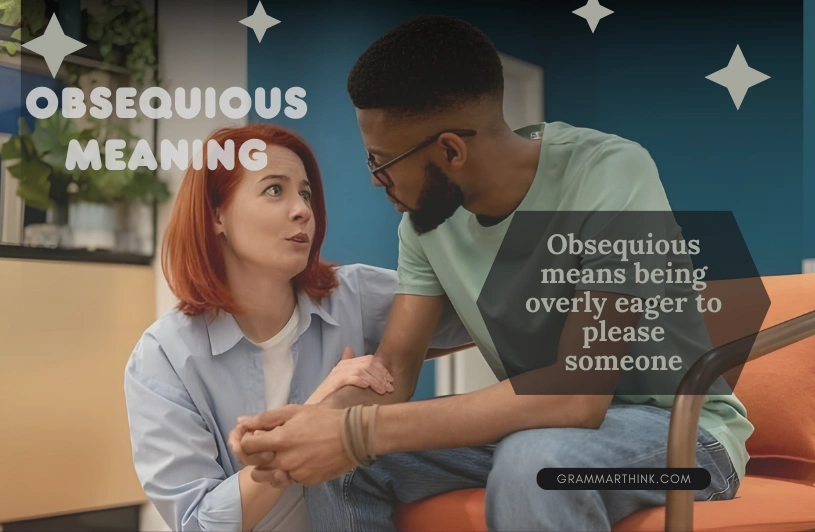
Obsequious meaning: excessively eager to please or obey, usually in a way that feels fake, creepy, or self-serving. It’s not a compliment. Ever.
Quick Stats: Obsequious
| Feature | Details |
|---|---|
| Word | Obsequious |
| Part of Speech | Adjective |
| Pronunciation | /əbˈsiːkwɪəs/ |
| Origin | Latin obsequiosus (15th century) |
| Tone | Negative / Disapproving |
| Register | Formal, literary |
| Common Context | Workplace, politics, social behavior |
| Top Synonym | Sycophantic, servile, fawning |
| Top Antonym | Assertive, bold, self-assured |
| Crossword Use | Frequent see “obsequious crossword clue” section |
So, What Is the Obsequious Meaning Really?
Here’s the short answer: obsequious meaning describes someone who is way too eager to please, serve, or agree not because they genuinely care, but because they want something in return.
Think of that one coworker who laughs at every single joke the boss makes, even the terrible ones. The person who suddenly volunteers for every task the moment a senior manager walks into the room. That’s obsequious behavior and most people can smell it from a mile away.
The word carries a heavy negative charge. When you call someone obsequious, you’re not saying they’re helpful. You’re saying they’re hollow. Their niceness is a performance, not a personality.
Obsequious Definition: By the Book
The obsequious definition, as given by Merriam-Webster, is: “marked by or exhibiting a fawning attentiveness.”
Oxford Languages adds: “obsequious persons are servilely compliant or deferential.”
But here’s what the dictionary doesn’t say obsequious meaning has a built-in accusation. It implies the person knows they’re doing it. This isn’t someone who’s just naturally polite. This is someone running a calculated charm operation.
Grammatical Overview
| Form | Example |
|---|---|
| Adjective | “He gave an obsequious bow.” |
| Adverb | “She smiled obsequiously at the director.” |
| Noun | “His obsequiousness was painful to watch.” |
The adjective form is by far the most common. You’ll see it in literary criticism, political commentary, and increasingly in modern workplace writing.
Origin & Etymology: Where Did This Word Come From?
The word traces back to Latin obsequium, meaning “compliance” or “dutiful service.” That root comes from obsequi, which means “to follow after” or “to comply.”
In its earliest uses during the 15th century, obsequious actually carried a neutral or even positive meaning. It simply meant “dutiful” or “attentive.” A good servant could be described as obsequious without any side-eye attached.
Shakespeare changed all that.
By the 16th and 17th centuries, writers began using the word to mock excessive flattery. Shakespeare himself used it sarcastically in works like Hamlet and Richard III. Once Shakespeare gets hold of a word, it rarely comes back the same.
By the 18th century, the modern obsequious meaning was locked in: fake, fawning, and frankly embarrassing.
Obsequious in Different Contexts
In the Workplace
This is where obsequious gets its biggest workout. The obsequious sycophant in an office setting is the person who:
- Agrees with every management decision, even bad ones
- Takes credit quietly while loudly praising the boss
- Changes their opinion the second a superior walks in
A 2024 study from the Journal of Organizational Behavior found that employees rated as highly obsequious by their peers were 32% less likely to be trusted by colleagues, even when they received more short-term praise from management. The long game doesn’t favor the flatterer.
In Politics
Politicians are frequently accused of obsequious behavior toward donors, toward party leaders, or toward powerful foreign allies. The word shows up constantly in political journalism precisely because it captures something more specific than “polite” or “agreeable.”
In Literature
The most famous obsequious character in English literature? Possibly Uriah Heep from Charles Dickens’ David Copperfield a man so slippery and fawning that his name became a shorthand for dishonest sycophancy.
In Everyday Social Life
The obsequious friend who tells you every outfit looks amazing. The date who agrees with everything you say. The neighbor who compliments your lawn every single morning. Context matters sometimes what looks obsequious is genuine. But usually? You can tell.
Obsequious Synonym: Words That Mean the Same Thing
| Obsequious Synonym | Shade of Meaning |
|---|---|
| Sycophantic | Focused on self-gain through flattery |
| Fawning | Overtly affectionate to gain favor |
| Servile | Slave-like submission |
| Unctuous | Oily, insincere smoothness |
| Subservient | Lacking independence or backbone |
| Ingratiating | Trying too hard to be liked |
| Toadying | Informal; pure flattery for gain |
The obsequious synonym you reach for depends on the context. Fawning is more emotional. Servile is more about power dynamics. Unctuous is perfect for someone who feels slippery and fake at the same time.
Obsequious Antonyms: The Opposite Energy
| Obsequious Antonyms | What It Means |
|---|---|
| Assertive | Confident in stating opinions |
| Forthright | Honest and direct |
| Bold | Unafraid to push back |
| Independent | Not seeking approval |
| Dominant | Takes charge rather than defers |
| Candid | Tells the truth even when inconvenient |
The best obsequious antonyms share one thing: backbone. These words describe people who don’t shape their behavior around what others want to hear.
Obsequious Example Sentences
Here are real-usage examples to cement the obsequious meaning in your head:
- “The new intern’s obsequious compliments made everyone uncomfortable at the team lunch.”
- “His obsequious behavior around senior partners was so obvious it actually hurt his career.”
- “She responded to every criticism with an obsequious smile that never quite reached her eyes.”
- “The senator’s obsequious praise of the billionaire donor raised eyebrows across the chamber.”
- “Don’t be obsequious give me your real opinion, not the one you think I want.”
- “His obsequious bowing and scraping made him the most talked-about character at the party not in a good way.”
Obsequious Sycophant: Is There a Difference?
Great question and most articles skip this entirely.
A sycophant is a noun: a person who flatters for gain. Obsequious is an adjective: the quality of behaving that way. So an obsequious sycophant is technically a double description you’re naming the person and describing their behavior at once.
It’s not redundant though. “Obsequious sycophant” hits harder than either word alone. It’s the difference between calling someone a liar and calling them a calculated, practiced liar. The obsequious sycophant knows exactly what they’re doing and they’re good at it.
Warning most articles skip: Not all people-pleasers are obsequious. People-pleasing can come from anxiety, trauma, or cultural conditioning. Obsequious behavior specifically implies strategic deference the person is calculating, not just insecure. Don’t use the word carelessly on someone who’s simply anxious or overly polite.
Obsequious Crossword Clue: Why This Word Shows Up So Often
If you’ve landed here from a crossword puzzle, you’re in good company. The obsequious crossword clue appears regularly in major publications including The New York Times and LA Times crosswords.
Common clues include:
| Clue Phrasing | Answer |
|---|---|
| “Too eager to please” | OBSEQUIOUS |
| “Fawning in manner” | OBSEQUIOUS |
| “Like a yes-man” | OBSEQUIOUS |
| “Overly compliant” | OBSEQUIOUS |
The word is crossword gold: long, distinctive, and hard enough to feel like a real win when you get it.
Obsequious Sorts: Who Are These People?
The phrase obsequious sorts refers to a type of person not just one individual. It’s a category.
Obsequious sorts tend to:
- Thrive in hierarchical environments (corporations, politics, academia)
- Adjust their personality based on who’s in the room
- Receive short-term rewards while losing long-term respect
- Eventually get exposed because consistency is not their strong suit
Research from Harvard Business Review (2023) found that managers who initially favored highly agreeable, flattering employees later rated those same employees as less trustworthy after 18 months on the job. The obsequious meaning plays out in real organizational data.
Read Also: Soxer Meaning
Related Terms Worth Knowing
- Sycophancy — the practice of obsequious behavior
- Toadyism — an older, more colorful word for the same thing
- Flattery — the tool obsequious people use most
- Deference — not always obsequious; sometimes genuine
- People-pleasing — broader, not always strategic
Conclusion: The Word That Sees Through the Smile
Obsequious meaning isn’t complicated it’s the word for people who perform kindness for personal gain. Whether you’re spotting an obsequious sycophant in a meeting room, solving an obsequious crossword clue at 11pm, or looking up the obsequious definition for a school essay, the word does one job well: it names a specific, recognizable, slightly uncomfortable human behavior.
The obsequious meaning is also a warning. If someone calls you obsequious, they’re not saying you’re too nice. They’re saying your niceness isn’t trusted.
The best obsequious antonyms assertive, candid, bold remind us what the alternative looks like. And the finest obsequious synonym options (fawning, servile, unctuous) show us the word isn’t alone. There’s a whole vocabulary built around calling out hollow flattery.
Use the word wisely. Or better yet, be the person it never gets used for.
? FAQs
Q1: Is obsequious always a negative word?
Yes in modern usage, the obsequious meaning is almost universally negative. Historically it was neutral, but today calling someone obsequious is a criticism.
Q2: What is the best obsequious synonym for casual conversation?
“Fawning” or “sycophantic” work well. For informal use, “kiss-up” or “yes-man” capture the same obsequious meaning without the formal register.
Q3: What are the most common obsequious antonyms?
Assertive, candid, and forthright are the clearest obsequious antonyms they all point toward honesty and self-confidence rather than people-pleasing.
Q4: What is the obsequious crossword clue I keep seeing?
Most commonly it’s clued as “fawning,” “too eager to please,” or “like a toady.” The obsequious crossword clue appears frequently because the word fits long grid slots well.
Q5: What’s the difference between obsequious and polite?
Politeness is sincere. Obsequious behavior is calculated. The difference lies in intent one is about respect, the other is about gain.
Q6: Can obsequious sorts ever succeed long-term?
Rarely in a meaningful way. Research consistently shows that obsequious sorts gain short-term approval but lose long-term trust, often more rapidly than they expect.
